
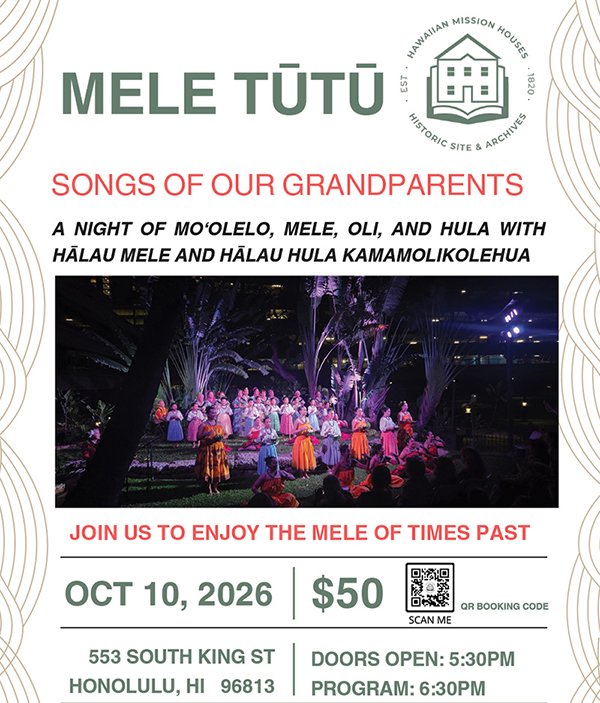
The Hawaiian Mission Houses Historic Site and Archives (HMH) invites the community to experience “Mele Tūtū: Songs of our Grandparents”, the next installment of HMH’s acclaimed Mele Program. “Mele Tūtū means to invite guests to look closely at the memories and songs of our grandparents or great-grandparents’ generation from the 1930s/1940s. Connection to our kūpuna, our elders, helps us to maintain the genealogies, histories, and mana of generations that we revere today. Expressed through mele (song), oli (chant), and hula (dance), Mele Tūtū embodies the enduring principle of Mālama Kūpuna: caring for our elders and those whose shoulders we all stand upon in our present-day lives.
In the 1930s and 1940s, during the time of our grandparents and great-grandparents, live music performances and radio broadcasts were important ways of sharing local music not only across the islands, but also to the Continental U.S. and further abroad. Radio shows like “Hawaiʻi Calls” and its descendant program in the 1970s and 1980s, “Territorial Airwaves” helped to broadcast Hawaiian music, mele, and culture to people otherwise unfamiliar with Hawaiʻi, its history, or its people. Orchestras playing hapahaole music, jazz, and other forms of popular Hawaiian music were instrumental in connecting people across the airwaves.
For many kamaʻāina, the mele and hula of the 1930s and 1940s are direct connections to their ancestors who danced hula, played in world-renowned touring Hawaiian bands, and kept the memory and music of previous generations alive in new contemporary ways for the time period. These mele and hula evoke memories of family musicians in the yard or on the lānai, at family gatherings, or times when kūpuna would share the knowledge and history of the family with the younger generations. It brings back memories of joy, happiness, fun, and genuine connection between family members.